
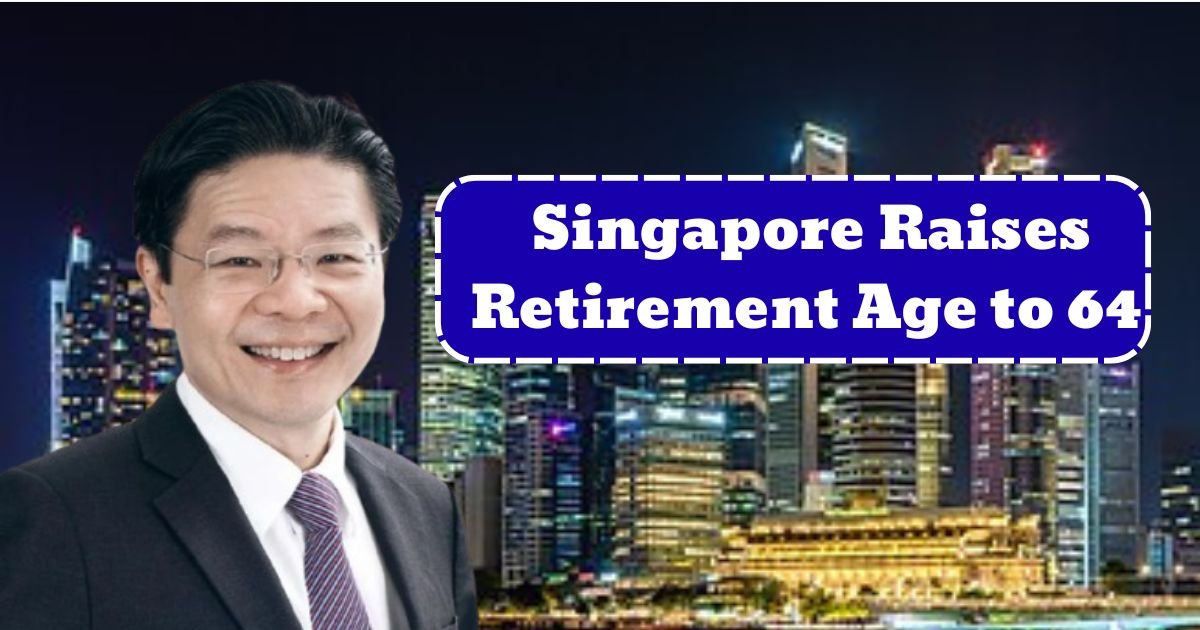
A very significant change is about to happen in Singapore’s bustling urban environment, where innovation and age-old customs meet. In response to the challenges of an ageing population and a drop in birth rates, the government has lifted the retirement age from 62 to 64, starting on July 1, 2026. This move not only extends workers’ rights until their legal age but also takes into account longer life expectancy, thus empowering the elderly to stay in the job market longer. It is an economic strain-relieving strategy that expands the inclusion base while at the same time increasing the productivity of one of Asia’s most dynamic economies.
The Announcement Details
The Ministry of Manpower of Singapore made this announcement public during the discussion of the Committee of Supply 2024.
The retirement age goes up from 63 to 64, and the age for re-employment will move from 68 to 69.
The new regulation applies to Singapore citizens and permanent residents born on or after July 1, 1963.
Timeline Of Increases
The increases have been planned in such a way that there will be no disruption as they will be phased in.
- Present situation: Retirement at 63, re-employment at 68.
- July 1, 2026: Retirement at 64, re-employment at 69.
- By 2030: Retirement at 65, re-employment at 70.
The public sector will adopt the changes earlier, from July 2025, while NTUC will follow suit from January 2025.
Reasons For The Change
The primary cause of this policy is the growing population of older citizens.
Aging will be so pronounced that one-quarter of the population in Singapore will be 65 years and older in 2030.

Such a measure would be resorted to in order to keep the economy alive when the birth rates are not encouraging.
It would mean giving people a better life since they would have the option to work according to their schedule.
The senior employment rates in Singapore are among the highest in the world.
Impacts On Workers
The age limit for dismissing workers on the basis of age will be extended.
Conditions for the offers of re-employment will be reasonable and if there is a need, adjustments will be made.
The provision of training to workers in order to make them more knowledgeable in the field of their interests is being done by the company.
Comparison Of Ages
| Category | Current (2025) | From 2026 | By 2030 |
|---|---|---|---|
| Retirement Age | 63 | 64 | 65 |
| Re-employment Age | 68 | 69 | 70 |
The table above shows the rise in ages step by step.
CPF And Savings Unaffected
The withdrawal of CPF at 65 remains the rule but it is not connected with the retirement age.

One can choose to put off the withdrawals for up to 70 years which will make the amount larger.
The upper limit for withdrawal at 55 still remains the same.
Support For Seniors
The Government is helping through various methods:
- Senior Employment Credit: Up to 7% of the total salary paid as a credit for an employee aged 60 and above.
- SkillsFuture credits for training.
- Tripartite guidelines for fair re-employment.
Wrongful dismissal appeals are also an option.
Looking Ahead
Such scenarios of high are indeed turning Singapore into a slowly but surely growing trajectory for the long-term.
It creates a win-win situation for both employees and the economy.
All concerned must start making advanced preparations as the year 2026 nears.

 Join
Join